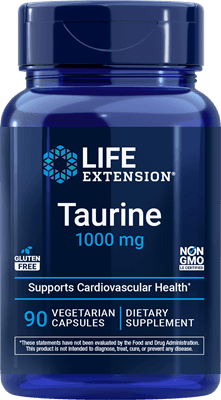
TL;DR — Taurine is a sulfur-containing amino acid that buffers mitochondrial and membrane stress; blood levels fall sharply with age. Tier B: Singh 2023 Science linked deficiency to aging hallmarks and extended lifespan in mice. 1–3 g/day; retest subjective energy and hs-CRP at week 12.
What taurine does (and why it matters)
Taurine concentrations in human blood decline roughly 80% between youth and old age. Singh et al. (PMID 37289866) showed taurine supplementation reversed multiple aging markers and extended lifespan across species — one of the strongest recent animal longevity signals for a simple OTC amino acid.
Primary hallmarks targeted: Mitochondrial dysfunction · Genomic instability · Chronic inflammation
PMID 37289866 — Taurine deficiency as a driver of aging (Science, 2023). Strong animal lifespan and multi-hallmark data; human longevity endpoints not yet established in large RCTs.
Mechanism
| Pathway | Mechanism | Hallmark link |
|---|---|---|
| Mitochondrial buffering | Stabilizes ETC complexes and calcium handling | Mitochondrial dysfunction |
| Antioxidant support | Conjugates bile acids; reduces ROS | Inflammation |
| DNA protection | Reduces oxidative DNA damage in animal models | Genomic instability |
When taurine is worth your money
Taurine earns a stack slot when two or more apply:
- Age 50+ with declining energy or exercise recovery
- Low dietary taurine (minimal seafood/meat)
- Complementary to NAD+ or glutathione restoration stacks
Skip or defer if you have kidney disease without physician clearance.
Evidence summary
| Study | Design | Key outcomes | Tier |
|---|---|---|---|
| Singh 2023 | Multi-species + human association | Lifespan extension mice; taurine correlates with healthspanThe portion of life spent in good health, free from chronic disease or disability — distinct from lifespan (total years alive). Full glossary → | B |
← Swipe for more columns →
Consensus: Mechanistically compelling and safe at food-supplement doses; treat as Tier B adjunct, not stack foundation until human longevity RCTs publish.
Where taurine disappoints
- The famous result is mouse lifespan plus human association, not a human trial. The 2023 Science paper is a strong signal — but extending it to "taurine will make people live longer" is extrapolation the data doesn't yet support. - Well-fed omnivores may already be replete. If you eat meat and seafood regularly, adding taurine may do little; the deficiency story is most relevant to low intake and advanced age. - The functional payoff is subtle. Energy and recovery changes, when they occur, are modest and easy to confuse with placebo. Many people feel nothing and that is a legitimate outcome, not a dosing error.
What would change this grade. Taurine is B because the mechanism and cross-species data are strong but human outcome trials are missing. It would rise to A with an adequately powered human RCT showing a hard aging or disease endpoint. It would fall if such trials show the striking animal lifespan effect fails to translate to people.
Dosing protocol
- Start: 1 g/day with food
- Target: 1–3 g/day split AM/PM
- Duration: 12+ weeks before judging
- Retest: Subjective energy log + hs-CRP if available
Should you start taurine?
Age 45+ with energy decline and no kidney contraindication?
Add 1 g/day for 4 weeks, titrate to 2–3 g
Prioritize Tier A stack foundation (GlyNAC/NMN) first
Chronic kidney disease or dialysis → physician clearance before supplementing
Educational decision aid — a way to organize the evidence, not a prescription. Doses and timing shown are those used in studies; confirm anything you act on with a clinician or pharmacist.
Monitoring
Taurine has no validated blood "level" for consumers to chase, so track function and the inflammatory/metabolic markers it plausibly moves.
| Biomarker | Target | Frequency | Action if off-target |
|---|---|---|---|
| hs-CRP | <1.0 mg/L | Baseline, 12 wk | Persistently high → audit sleep, exercise, and stack, not dose alone |
| Resting heart rate | ↓2–4 bpm trend | Weekly wearable | Rising → review stimulants and sleep |
| Blood pressure | Within your target range | Monthly | Taurine can lower BP — recheck if on antihypertensives |
| Subjective energy / recovery | ≥7/10 | Daily log | Flat at 12 wk → taurine is likely not your limiting factor |
← Swipe for more columns →
hs-CRP
1.5–3.0 mg/L
Resting HR
66–74 bpm
Exercise recovery
Slow
hs-CRP
<1.5 mg/L
Resting HR
62–70 bpm
Exercise recovery
Moderate+
Safety, red flags, and contraindications
- Well tolerated: 1–6 g/day has a strong human safety record in cardiovascular and metabolic studies.
- Renal clearance: Taurine is cleared by the kidneys — reduced clearance in CKD warrants physician oversight.
- Blood pressure: May potentiate antihypertensive medication; monitor if you already take BP-lowering drugs.
Do not self-start without clearance
- Chronic kidney disease or dialysis — impaired taurine clearance; physician clearance required
- Pregnancy or breastfeeding — insufficient supplemental-dose safety data
- On antihypertensives — additive BP lowering; monitor and coordinate with your prescriber
- Bipolar disorder — high-dose amino-acid loading should be physician-supervised
Who should skip taurine
- Chronic kidney disease or dialysis — taurine is renally cleared; needs physician oversight. - Regular meat-and-seafood eaters expecting a dramatic effect — you may already be replete; the money is better spent on a Tier-A foundation. - Pregnancy/breastfeeding — insufficient supplemental-dose safety data.
Synergies and antagonists
Pairs well with:
| Partner | Rationale | Guide |
|---|---|---|
| NMN | Taurine buffers mitochondrial membranes while NAD+A molecule every cell needs for energy production, DNA repair, and activating longevity genes (sirtuins). Full glossary → restores repair capacity | NAD+ Mito Stack |
| GlyNAC | Orthogonal redox defense — glutathioneYour body's most abundant internal antioxidant, made from glycine, cysteine, and glutamate. Full glossary → + membrane stabilization | GlyNAC module |
| Magnesium | Complementary electrolyte and neuromuscular support | NMN module |
Works against / redundant with:
| Antagonist | Conflict | What to do |
|---|---|---|
| Antihypertensive medication | Taurine can lower blood pressure — additive effect may over-shoot | Monitor BP and coordinate dose with your prescriber |
| — | No well-characterized supplement antagonists at 1–3 g/day | Taurine is unusually easy to co-stack; the only real limiter is renal clearance |
Personal results template
My taurine results log
| Date | Week | Dose | hs-CRP | Energy (1–10) | RHR | BP | Notes |
|---|---|---|---|---|---|---|---|
| YYYY-MM-DD | 0 | — | — | — | — | — | Baseline |
| YYYY-MM-DD | 4 | 1 g | — | — | — | — | Early tolerance check |
| YYYY-MM-DD | 12 | 2–3 g | — | — | — | — | Primary endpoint |
← Swipe for more columns →
Response criteria (personal, not clinical): - Meaningful: hs-CRP trending down + energy ↑2 points sustained 4+ weeks - Plateau: No change by week 12 → deprioritize; foundation (sleep, Zone 2, Tier A stack) matters more - Adverse: Symptomatic low BP, GI upset → reduce dose and reassess
Track taurine alongside your redox panel
Log hs-CRP and resting HR to judge taurine on trend, not a single reading.
Open Labs hubReferences
- Singh P et al. Taurine deficiency as a driver of aging. Science (2023). PMID 37289866
Links open PubMed. TNiC does not sell supplements; citations support education, not medical advice.