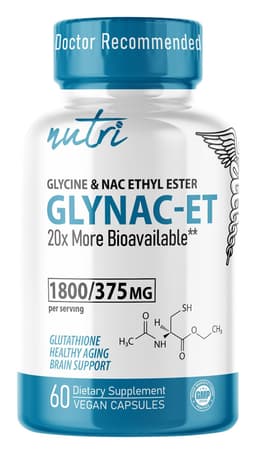
TL;DR — GlyNAC supplies the two age-limiting glutathione precursors in one dose. Tier A evidence for restoring GSH, lowering oxidative stressAn imbalance between reactive oxygen species (free radicals) produced by metabolism and the antioxidant systems that neutralize them. Full glossary →, and improving mitochondrial markers in older adults over 24 weeks. Start 600 mg glycine + 600 mg NAC each morning; retest GSH at weeks 12 and 24.
What GlyNAC does (and why it matters)
GlutathioneYour body's most abundant internal antioxidant, made from glycine, cysteine, and glutamate. Full glossary → (GSH) is your cells' master redox buffer — protecting mitochondrial Complex I/III, detoxifying electrophiles, and keeping NF-κB quiet. After age 20, GSH declines ~10–15% per decade, creating a bottleneck that no single antioxidant pill can fix.
GlyNAC combines the two limiting precursors for endogenous GSH synthesis:
- Glycine — second limiting factor in older adults (Kumar et al.)
- NAC — bioavailable cysteine after deacetylation; often rate-limiting at any age
Primary hallmarks targeted: Mitochondrial dysfunction · Loss of proteostasis · Chronic inflammation · Genomic instability
Kumar et al. randomized older adults to GlyNAC for 24 weeks: restored erythrocyte GSH, reduced oxidative stress markers, improved mitochondrial function, and lowered insulin resistance. PMID 33783984, 35975308.
Mechanism — why both precursors, not NAC alone
Glutathione is a tripeptide (γ-L-glutamyl-L-cysteinylglycine). Synthesis requires cysteine, glycine, and glutamate — but in aging, cysteine and glycine jointly limit output.
| Pathway | Mechanism | Hallmark link |
|---|---|---|
| Redox cycling | GSH ↔ GSSG maintains cysteine residues on proteins | Proteostasis |
| Detoxification | GSH conjugates electrophiles via GST | Genomic stability |
| Mitochondrial defense | Mito GSH pool protects Complex I/III from ROS | Mitochondrial dysfunction |
| Inflammation | Reduced ROS → lower NF-κB activation | Chronic inflammation |
NAC alone can raise cysteine but may not overcome glycine insufficiency in aging. Human trials used the combination — that is the evidence-backed unit of intervention.
The chemistry all runs through one group: the cysteine thiol (–SH). That sulfhydryl is the reactive end of glutathione — the site that donates electrons to neutralize oxidants and cycles between reduced (GSH) and oxidized (GSSG) states. Glycine and glutamate complete the tripeptide, but the thiol is what does the redox work, which is why cysteine availability — supplied here as NAC — is so often the rate-limiting factor.
When GlyNAC is worth your money
GlyNAC earns a place in your stack when two or more apply:
- Age 50+ with subjective energy ≤6/10
- GSH below 5.0 μmol/L (or never tested with high oxidative stress lifestyle)
- hs-CRP above 1.0 mg/L with no acute infection
- You're building an NRF2 stack and need substrate before gene induction
Skip or defer if sleep is under 6 hours, alcohol intake is high, or you haven't run 8 weeks of lifestyle foundation — GlyNAC cannot substitute for those.
Evidence summary
| Study | Design | N | Duration | Key outcomes | Tier |
|---|---|---|---|---|---|
| Kumar 2021 (PMID 33783984) | RCT | 24 | 24 wk | ↑ GSH, ↓ oxidative stress, ↑ mitochondrial function | A |
| Kumar 2023 (PMID 35975308) | RCT extension | 24 | 36 wk | Sustained GSH, improved insulin sensitivity | A |
| Sekhar 2011 | Pilot RCT | 8 | 2 wk | ↑ GSH in elderly with oxidative stress | B |
← Swipe for more columns →
Consensus: Tier A for glutathione restoration and oxidative stress reduction in older adults. Longevity outcome data (mortality, healthspanThe portion of life spent in good health, free from chronic disease or disability — distinct from lifespan (total years alive). Full glossary → years) does not yet exist — biomarker and functional improvements are the measured endpoints.
Where GlyNAC disappoints
- The strongest trials are small and from one group. The pivotal RCTs are well-designed but modest in size (~24 per arm) and largely from a single research lab — broad independent replication is still thin. The grade rests on mechanism plus consistent within-lab results, not a large multi-center literature. - It corrects a deficit, so young or GSH-replete people benefit less. The dramatic reversals were in older adults with measurably low glutathione. If yours is already in range, expect little. - If you already take NAC and eat plenty of collagen/glycine, the incremental gain from the combination may be small — GlyNAC's edge is supplying both limiting precursors at once.
Should you start GlyNAC?
GSH below 5.0 μmol/L OR hs-CRP above 1.0 mg/L?
Start 600/600 mg AM → labs at week 12 and 24
node | Energy ≤5/10 for 4+ consecutive weeks?
12-week trial with daily energy log → add labs at week 12
node | Already taking NAC 600 mg alone?
Add glycine 600 mg — you're halfway to the trial dose
Prioritize sleep + Zone 2 for 8 weeks → retest subjective energy
Active chemotherapy, nitroglycerin use, or uncontrolled asthma → physician clearance before starting
Educational decision aid — a way to organize the evidence, not a prescription. Doses and timing shown are those used in studies; confirm anything you act on with a clinician or pharmacist.
What would change this grade. GlyNAC is A for glutathione restoration in older adults — not for longevity outcomes. It would hold or strengthen that grade with large, independent, multi-center replication, and earn an outcome-level grade only with a trial showing hard endpoints (function, disease, mortality). It would fall if independent groups fail to reproduce the GSH and mitochondrial gains.
Dosing protocol
| Parameter | Recommendation | Notes |
|---|---|---|
| Glycine | 600 mg | Trial dose; some protocols use 1–3 g |
| NAC | 600 mg | Take with food if GI sensitive |
| Timing | AM, empty or light stomach | Pairs with NRF2A protein that turns on 200+ antioxidant and detox genes when activated. Full glossary → stack morning block |
| Duration | Minimum 12–24 weeks | Trial signal at 24 weeks |
| Cycling | Optional 5 days on / 2 off | Not required by trial data |
| Precursor half-life | NAC ~6 h · glycine ~1 h | Both are short-lived in plasma — daily dosing keeps synthesis substrate topped up; there's no benefit to a single large bolus |
AM choreography (NRF2 Defense Triad)
- GlyNAC — substrate first
- Sulforaphane — 15–30 min later (NRF2 gene induction)
- R-ALA — with breakfast (redox recycling)
Week-one compliance checklist
- [ ] Set AM alarm label: "GlyNAC → wait 20 min → sulforaphane"
- [ ] Log baseline GSH / hs-CRP if available
- [ ] Note sulfur odor from NAC — normal, not a side effect
- [ ] If nausea day 1–3, take with small fat-containing snack
- [ ] Calendar reminders for week 12 and 24 lab draws
Add GlyNAC to your stack
Toggle GlyNAC in the NRF2 Defense stack and watch synergyWhen two compounds together produce greater effect than either alone. Full glossary → score update with sulforaphane and R-ALA.
Open Stack ArchitectMonitoring
| Biomarker | Target | Frequency | Action if off-target |
|---|---|---|---|
| Glutathione (GSH) | 5.0–8.5 μmol/L | Baseline, 12 wk, 24 wk | Continue protocol; reassess dose at 24 wk |
| 8-OHdG | Trending down | 6 months | Pair with sleep optimization |
| hs-CRP | <1.0 mg/L | 3–6 months | Add anti-inflammatory lifestyle |
| Fasting glucose | <100 mg/dL | 3 months | Kumar trial showed insulin sensitivity gains |
← Swipe for more columns →
Erythrocyte GSH
Below 5.0
Oxidative stress markers
Elevated
Subjective energy
5–6/10
Fasting glucose
Borderline
Erythrocyte GSH
5.0–8.5 μmol/L
Oxidative stress markers
Trending down
Subjective energy
7–8/10
Fasting glucose
Improved sensitivity
Track your GSH trend
Upload lab CSV or log GSH manually to see optimal/watch/critical status over time.
Open Labs hubSafety, red flags, and contraindications
- Generally well tolerated in trial populations (older adults, 24–36 weeks)
- NAC: May cause nausea — take with food; sulfur odor is normal
- Not a substitute for: Sleep, exercise, or physician-managed conditions
Do not self-start without clearance
- Active chemotherapy — theoretical antioxidant interference with some regimens
- Nitroglycerin — NAC may potentiate hypotensive effects
- Uncontrolled asthma — rare bronchospasm reports with high-dose NAC
- Persistent GI intolerance past week 2 — reduce NAC to 300 mg; if continues, discontinue
Who should skip GlyNAC
- Young adults with normal glutathione — you'd be correcting a deficit you don't have. - Anyone on nitroglycerin, in active chemotherapy, or with uncontrolled asthma — real interaction risks; get clearance first. - Athletes timing it around key training — high-dose NAC can blunt the exercise adaptations you're training for; keep it away from your hardest sessions.
Synergies and antagonists
Pairs well with:
| Partner | Rationale | Guide |
|---|---|---|
| Sulforaphane | NRF2 upregulates GSH synthesis enzymes (GCLC, GCLM) | NRF2 Defense Triad |
| R-ALA | Recycles GSH from GSSG; supports mitochondrial redox | NRF2 Defense Triad |
| NMN | Complementary — NAD+ for PARP repair while GSH handles ROS | NAD+ Mito Stack |
Works against / redundant with:
| Antagonist | Conflict | What to do |
|---|---|---|
| Nitroglycerin / nitrate vasodilators | NAC can potentiate hypotension and nitrate tolerance | Do not combine without physician management |
| High-dose antioxidant timing around exercise | NAC's ROS-quenching can damp training adaptation signals | Keep GlyNAC away from your key training window |
| Standalone NAC already in the stack | Redundant cysteine leg — you're paying twice for the same precursor | Add glycine to your existing NAC rather than a second NAC source |
Personal results template
My GlyNAC results log
Copy this table into your notes app or the Labs hub. Update at baseline, week 12, and week 24.
| Date | Week | Dose (gly/NAC) | GSH (μmol/L) | hs-CRP | Energy (1–10) | Sleep quality (1–10) | Subjective notes |
|---|---|---|---|---|---|---|---|
| YYYY-MM-DD | 0 | 600/600 mg | — | — | — | — | Baseline |
| YYYY-MM-DD | 12 | 600/600 mg | — | — | — | — | Mid-point check |
| YYYY-MM-DD | 24 | 600/600 mg | — | — | — | — | Primary endpoint |
| YYYY-MM-DD | 36 | 600/600 mg | — | — | — | — | Extension / maintenance |
← Swipe for more columns →
Response criteria (personal, not clinical): - Meaningful: GSH enters optimal range OR hs-CRP drops ≥30% with improved energy - Plateau: No biomarker or subjective change at 24 wk → review dose, compliance, sleep - Adverse: GI intolerance → take with food; persistent nausea → reduce NAC to 300 mg
Log your experiment
Document your GlyNAC protocol as a journey milestone for longitudinal tracking.
Personal journeyReferences
- Kumar P et al. GlyNAC supplementation improves glutathione deficiency in aging humans. J Gerontol A Biol Sci Med Sci (2021). PMID 33783984
- Kumar P et al. GlyNAC improves multiple hallmarks of aging in 16-week RCT. J Gerontol A (2023). PMID 35975308
Links open PubMed. TNiC does not sell supplements; citations support education, not medical advice.