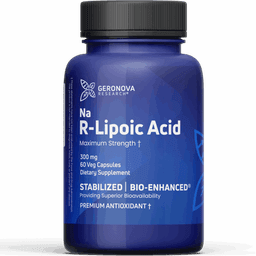
TL;DR — R-ALA is the mitochondrial redox recycler — it recycles oxidized glutathione back to active GSH, regenerates vitamins C and E, and activates NRF2 to prime phase-II detox. Tier B evidence; most human data is in diabetic neuropathy and metabolic syndrome. Its real value in healthy adults is as the third leg of the NRF2A protein that turns on 200+ antioxidant and detox genes when activated. Full glossary → Defense Triad, completing the substrate → signal → recycle loop. Take 300 mg with a fat-containing breakfast; use the stabilized R-form only.
What R-ALA does (and why it matters)
The mitochondrial respiratory chain produces ROS as a byproduct of ATP synthesis. Without ongoing recycling, oxidized antioxidants pile up — vitamin C becomes dehydroascorbate, vitamin E becomes the tocopheroxyl radical, and glutathioneYour body's most abundant internal antioxidant, made from glycine, cysteine, and glutamate. Full glossary → (GSSG) accumulates. R-ALA interrupts this at every level simultaneously.
Primary hallmarks targeted: Mitochondrial dysfunction · Loss of proteostasis · Chronic inflammation
R-ALA is uniquely positioned because it operates in both aqueous and lipid compartments — meaning it catches ROS at the inner mitochondrial membrane (lipid) and in cytosol (aqueous), a dual range no single antioxidant vitamin achieves alone.
R-ALA has robust mechanism data and positive outcomes in diabetic neuropathy (Ziegler et al., PMID 11916459; Alpha-Lipoic Acid in Diabetic Neuropathy meta-analysis). Human longevity-specific RCTs in healthy adults are limited. Evidence grade reflects evidence quality in the target population, not mechanism clarity.
Mechanism — the mitochondrial recycler
| Function | Pathway | Hallmark link |
|---|---|---|
| GSH recycling | Reduces GSSG → GSH via thioredoxin pathway | Mitochondrial dysfunction |
| Vitamin C regeneration | Reduces dehydroascorbate → ascorbate | Genomic stability, proteostasis |
| Vitamin E regeneration | Reduces tocopheroxyl radical → tocopherol | Membrane integrity |
| NRF2 activation | Modifies KEAP1 Cys residues (less potent than sulforaphane) | Inflammation, proteostasis |
| Pyruvate dehydrogenase cofactor | Required for pyruvate → acetyl-CoA conversion | Mitochondrial energy flux |
Why the R-enantiomer matters: ALA exists as R- and S- isomers. Racemic supplements (50/50 mix) deliver only 50% of the biologically active form. The R-form binds mitochondrial enzymes more efficiently and achieves higher plasma levels. Use stabilized R-ALA formulations — unstabilized R-ALA polymerizes at room temperature, reducing bioavailabilityHow much of a compound actually reaches your bloodstream and tissues after you take it. Full glossary →.
R-ALA vs Sulforaphane for NRF2: Sulforaphane is the more potent NRF2 inducer (irreversible KEAP1 modification). R-ALA provides a complementary, milder NRF2 signal and—critically—recycles the GSH that sulforaphane's gene program upregulates. The two are not interchangeable.
When R-ALA earns a stack slot
R-ALA has clear value when two or more apply:
- You're running GlyNAC + sulforaphane and want to complete the NRF2 Defense Triad
- Age 50+ with oxidative stressAn imbalance between reactive oxygen species (free radicals) produced by metabolism and the antioxidant systems that neutralize them. Full glossary → markers elevated (8-OHdG, oxLDL)
- Metabolic health target: impaired fasting glucose or insulin resistance
- High exercise load (intense training generates mitochondrial ROS)
Skip or defer if: you're supplementing racemic (RS)-ALA — upgrade to R-form first. Also skip if you're not yet running sleep + exercise basics; recycling antioxidants you aren't producing doesn't move the needle.
Evidence summary
| Study / Review | Design | Population | Key outcomes | Tier |
|---|---|---|---|---|
| Ziegler 2011 (PMID 21309862) | Meta-analysis | Diabetic neuropathy | ↓ Neuropathy scores, ↓ oxidative stress | B |
| Göçmen 2002 | RCT | MetSyn | ↓ fasting glucose, ↓ TG | B |
| Hagen 2002 | Animal | Aged rat mito | ↑ mitochondrial activity, ↑ memory | — |
| Reed 2002 | Mechanistic | In vitro/in vivo | Cofactor role for PDH, KGDH established | — |
← Swipe for more columns →
Consensus: Strong mechanism and positive metabolic syndrome data. No large RCT in healthy older adults for longevity endpoints. Tier B is honest — do not expect Tier A human outcome data that does not yet exist. It earns its place in the NRF2 stack as the recycling layer, not as a standalone intervention.
Where R-ALA disappoints
- The human data are disease-specific. The good outcomes are in diabetic neuropathy and metabolic syndrome — not healthy-adult longevity. In a metabolically healthy person the standalone effect is small. - Most products are the wrong form. Cheap racemic (RS)-ALA is only 50% active and the R-form polymerizes if unstabilized — a lot of "it did nothing" is really a product problem. - Recycling needs something to recycle. R-ALA regenerates glutathione and vitamins C/E — its value depends on the substrate leg (GlyNAC) being in place; alone it's a recycler with little to recycle.
Should you add R-ALA to your stack?
Already running GlyNAC + sulforaphane?
Add R-ALA 300 mg AM with breakfast — completes NRF2 Defense Triad
node | Primary goal is metabolic health (glucose, insulin)?
R-ALA 300–600 mg standalone is worth a 12-week trial — baseline fasting glucose first
node | Running high-intensity training 4+ days/week?
300 mg with post-workout fat-containing meal supports mito ROS clearance
Start GlyNAC + sulforaphane first; add R-ALA in week 12+ as stack expansion
Thyroid hormone replacement (levothyroxine) — ALA may reduce T4→T3 conversion; monitor TSH every 3 months
Educational decision aid — a way to organize the evidence, not a prescription. Doses and timing shown are those used in studies; confirm anything you act on with a clinician or pharmacist.
Dosing protocol
| Parameter | Recommendation | Notes |
|---|---|---|
| Dose | 300 mg R-ALA | Evidence-calibrated; 600 mg for metabolic goals |
| Form | Stabilized R-ALA only | Avoid racemic (RS-ALA) — only 50% active form |
| Timing | AM with breakfast | Take with fat for absorption (fat-soluble component) |
| Duration | 12+ weeks | Redox benefits accumulate over weeks |
| Cycling | Optional 5 days on / 2 off | Not required; some users prefer continuous |
NRF2 Defense Triad choreography
- GlyNAC — 600 mg glycine + 600 mg NAC on waking (substrate)
- Sulforaphane — 15–30 min later (NRF2 gene induction)
- R-ALA — with fat-containing breakfast (redox recycling)
Spacing matters: sulforaphane induces GCLC/GCLM transcription 2–6 hours post-dose; R-ALA recycles the GSH that those enzymes are synthesizing. The sequence is mechanistically meaningful.
Week-one checklist
- [ ] Confirm R-form product (label must say "R-ALA" or "R-Alpha Lipoic Acid" — not just "ALA")
- [ ] Take with breakfast that includes ≥5g fat (avocado, eggs, olive oil)
- [ ] Log baseline energy and, if available, oxidative stress proxy (8-OHdG, oxLDL)
- [ ] If running with GlyNAC + sulforaphane, set AM alarm sequence
- [ ] Note: mild sulfur smell on breath — normal, not a side effect
Add R-ALA to your stack
Toggle R-ALA alongside GlyNAC and Sulforaphane to see the NRF2 Defense Triad synergyWhen two compounds together produce greater effect than either alone. Full glossary → score.
Open Stack ArchitectMonitoring
| Biomarker | Target | Frequency | Action if off-target |
|---|---|---|---|
| Glutathione (GSH) | 5.0–8.5 μmol/L | Baseline, 12 wk, 24 wk | R-ALA accelerates GSH restoration alongside GlyNAC |
| 8-OHdG | Trending down | 6 months | Pair with sleep optimization |
| Fasting glucose | <100 mg/dL | 3 months | R-ALA improves insulin sensitivity in metabolic syndrome |
| oxLDL | Trending down | 6 months | Vitamin E/C recycling reduces LDL oxidation |
← Swipe for more columns →
Safety, red flags, and contraindications
- Generally well tolerated in supplement doses (300–600 mg)
- GI sensitivity: Take with food — empty-stomach nausea is common
- Hypoglycemia risk: R-ALA mimics insulin signaling; monitor if diabetic or pre-diabetic
Interactions requiring physician review
- Thyroid hormone replacement (levothyroxine): ALA may reduce T4-to-T3 conversion — monitor TSH every 3 months if on replacement therapy
- Chemotherapy / platinum-based agents: ALA's antioxidant activity may theoretically interfere; oncologist clearance required
- Diabetic medications: Additive glucose-lowering; hypoglycemia risk — reduce oral agents under supervision
- Thiamine (B1) depletion: Very high dose ALA (>600 mg) may compete with thiamine; ensure B-vitamin adequacy
What would change this grade. R-ALA is B on disease-population data. A healthy-adult RCT showing a longevity-relevant benefit would broaden it; the neuropathy/metabolic evidence, however solid, won't move the general-use case. It stays a recycling layer, not a headline intervention.
Who should skip R-ALA
- Anyone taking racemic (RS)-ALA — upgrade to a stabilized R-form first, or you're paying for half-inactive product. - People on levothyroxine or diabetic medication — real interactions (T4→T3 conversion, additive hypoglycemia); monitor and coordinate. - Anyone not running the substrate stack (GlyNAC) or lifestyle basics — recycling antioxidants you aren't producing does little.
Synergies and antagonists
Pairs well with:
| Partner | Rationale | Guide |
|---|---|---|
| GlyNAC | R-ALA recycles the GSH that GlyNAC precursors synthesize — closing the redox loop | NRF2 Defense Triad |
| Sulforaphane | Sulforaphane upregulates GSH synthesis enzymes; R-ALA regenerates the substrate — substrate + signal + recycle | NRF2 Defense Triad |
| NMN | Complementary redox — R-ALA handles ROS while NMN fuels SIRT3 mitophagyA specific form of autophagy that selectively removes damaged or dysfunctional mitochondria, replacing them with healthy ones. Full glossary → | NAD+ Mito Stack |
Works against / redundant with:
| Antagonist | Conflict | What to do |
|---|---|---|
| Levothyroxine | ALA may reduce T4→T3 conversion | Monitor TSH every 3 months; separate dosing |
| Diabetic medication / insulin | Additive glucose-lowering → hypoglycemia | Coordinate with prescriber; take with a meal |
| High-dose antioxidant timing around exercise | Like other strong antioxidants, can blunt training-adaptation signaling | Keep megadoses away from key training sessions |
Personal results template
My R-ALA results log
Copy to your notes or Labs hub. Update at baseline, week 12, and week 24.
| Date | Week | Dose | GSH (μmol/L) | Fasting glucose | Energy (1–10) | Oxidative marker | Notes |
|---|---|---|---|---|---|---|---|
| YYYY-MM-DD | 0 | 300 mg | — | — | — | — | Baseline |
| YYYY-MM-DD | 12 | 300 mg | — | — | — | — | Mid-point |
| YYYY-MM-DD | 24 | 300 mg | — | — | — | — | Primary endpoint |
← Swipe for more columns →
Response criteria (personal): - Meaningful: GSH moves into optimal range OR fasting glucose drops ≥5 mg/dL, energy ↑1–2 points - Plateau: No change at 24 wk → confirm R-form product, add GlyNAC substrate if not already running - Adverse: Hypoglycemia symptoms → take with larger meal; if persistent, reduce dose to 150 mg
See the full NRF2 Defense Triad
R-ALA's clearest use case: completing the three-layer antioxidant architecture.
Read synergy guideReferences
Links open PubMed. TNiC does not sell supplements; citations support education, not medical advice.