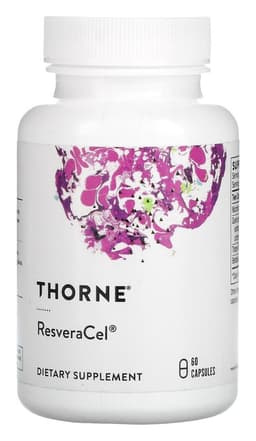
TL;DR — Trans-resveratrol allosterically activates SIRT1 and phosphorylates AMPK, mimicking caloric restriction signaling. Tier B for standalone human outcomes; strongest rationale as PM pair with AM NMN (cofactor + activator). 150–500 mg micronized trans-resveratrol with dinner; retest NAD+ at week 4.
What resveratrol does (and why it matters)
SIRT1 and AMPKAn energy-sensing enzyme activated when ATP is low — it promotes fat burning, mitochondrial biogenesis, and autophagy. Full glossary → are nutrient-sensing kinases that shift cells from growth mode toward repair — but SIRT1 is NAD+A molecule every cell needs for energy production, DNA repair, and activating longevity genes (sirtuins). Full glossary →-dependent. Resveratrol provides the activation signal; without adequate NAD+ from NMN, the engine revs with no fuel.
Trans-resveratrol (a grape polyphenol) directly stimulates SIRT1 deacetylation activity and activates AMPK, promoting PGC-1α → mitochondrial biogenesis, epigenetic chromatin remodeling, and NF-κB modulation.
Primary hallmarks targeted: Mitochondrial dysfunction · Epigenetic alterations · Disabled autophagyThe cellular self-cleaning process that breaks down and recycles damaged proteins, organelles, and pathogens. Full glossary → · Disabled macroautophagy (nutrient sensing) · Chronic inflammation
PMID 30930169 — NAD+ precursors and sirtuin activators synergize for mitochondrial health. Baur 2006 (PMID 17086191): resveratrol improves health markers in high-calorie fed mice. Human standalone trial outcomes are mixed; combination with NMN has stronger mechanistic rationale.
Mechanism — activator without cofactor fails
| Pathway | Mechanism | Hallmark link |
|---|---|---|
| SIRT1 → PGC-1α | Mitochondrial biogenesis | Mitochondrial dysfunction |
| SIRT1 → histones | Epigenetic stability | Epigenetic alterations |
| AMPK phosphorylation | Autophagy independent of mTOR | Autophagy · Nutrient sensing |
| NF-κB modulation | ↓ inflammatory transcription | Chronic inflammation |
Micronized formulations achieve 3–5× higher plasma levels vs standard powder — bioavailabilityHow much of a compound actually reaches your bloodstream and tissues after you take it. Full glossary → is the common failure mode in under-dosed protocols.
When resveratrol is worth your money
Resveratrol earns a stack slot when two or more apply:
- Already on NMN 250+ mg AM with confirmed NAD+ response
- Mitochondrial or epigenetic hallmark is top-3 priority
- Nutrient sensing / autophagy targets need AMPK support
- PM fat-containing meal is consistent (absorption requirement)
Skip or defer if not on NMN (or NR), PM meals are low-fat, on blood thinners without clearance, or lifestyle foundation (TRE, sleep, Zone 2) is not locked.
Evidence summary
| Study | Design | N | Duration | Key outcomes | Tier |
|---|---|---|---|---|---|
| Baur 2006 (17086191) | Mouse | — | Lifespan | Improved health on high-calorie diet | Preclinical |
| Yi 2022 (36482258) | Human RCT | 300–900 mg | 60 d | NMN ↑ NAD+ (pair rationale) | A (NMN leg) |
| Standalone human RCTs | Mixed | Varies | 4–12 wk | Inconsistent metabolic endpoints | B/C |
← Swipe for more columns →
Consensus: Tier B as standalone compound — strong mechanism, mixed human endpoints. Tier B→A as NMN pair based on cofactor-activator logic and stack architecture data.
Where resveratrol disappoints
- As a standalone longevity pill. Human trials of resveratrol alone are the classic example of a compelling mechanism that mostly failed to translate — metabolic endpoints came back inconsistent or null. - Bioavailability. Oral resveratrol is rapidly glucuronidated and sulfated; without a micronized form and a fat-containing meal, very little intact compound reaches tissue. Most disappointing protocols are simply under-absorbed. - When your primary goal is exercise adaptation. A controlled trial in older men found resveratrol actually blunted several of the cardiovascular and metabolic gains from endurance training — because it damps the very oxidative signaling exercise relies on. If training is your main lever, resveratrol can work against it.
Should you start resveratrol?
On NMN 250+ mg AM for 4+ weeks with NAD+ index responding?
node | PM dinner includes dietary fat (15g+)?
Start 150 mg PM → titrate to 250–500 mg over 4 weeks
Fix meal timing/fat first — absorption drops 50%+ without
Start NMN first → add resveratrol week 8 per SIRT1 pair
On warfarin, antiplatelet therapy, or active bleeding disorder — physician clearance (CYP and platelet theoretical interactions)
Educational decision aid — a way to organize the evidence, not a prescription. Doses and timing shown are those used in studies; confirm anything you act on with a clinician or pharmacist.
What would change this grade. Standalone resveratrol sits at B because the mechanism is strong but human outcomes are mixed and bioavailability is poor. It would rise with a well-powered RCT using a bioavailable formulation that shows a durable hard endpoint — not another surrogate marker. It would fall if further trials confirm the direct SIRT1-activation story doesn't hold in humans at achievable exposures.
Dosing protocol
| Parameter | Recommendation | Notes |
|---|---|---|
| Dose | 150–500 mg trans-resveratrol | Start low, titrate GI tolerance |
| Timing | PM with fat-containing meal | Dinner is standard anchor |
| Form | Micronized trans-resveratrol | Not cis-isomer or raw powder |
| Pairing | AM NMN 250–500 mg | Non-negotiable for SIRT1 logic |
| Duration | Minimum 12–24 weeks | Match NMN trial endpoint |
Week-one compliance checklist
- [ ] Confirm micronized trans-resveratrol label
- [ ] Lock PM meal with ≥15 g fat (olive oil, avocado, nuts)
- [ ] NMN AM dose running 7+ days before adding resveratrol
- [ ] Schedule NAD+ index at week 4
- [ ] Read SIRT1 pair choreography
Add resveratrol to your stack
Enable SIRT1 pair or NAD+ Mito Stack for pre-built AM/PM spacing and synergyWhen two compounds together produce greater effect than either alone. Full glossary → scoring.
Open Stack ArchitectMonitoring
| Biomarker | Target | Frequency | Action if off-target |
|---|---|---|---|
| NAD+ index | 80–100 | 4 wk, 12 wk | Verify NMN dose before raising resveratrol |
| HbA1c | <5.7% | 6 mo | AMPK may improve insulin sensitivity |
| Resting HR | ↓ 2–5 bpm trend | Weekly wearable | Mito efficiency proxy |
| Subjective energy | ≥7/10 AM | Daily | Primary N=1 signal |
← Swipe for more columns →
NAD+ index
60–75
Morning energy (1–10)
≤5
Resting HR (bpm)
Baseline
NAD+ index
80–100
Morning energy (1–10)
≥7
Resting HR (bpm)
↓ 2–5
Track biomarkers
Log NAD+ index at week 4 and 12; HbA1c at 6 months if metabolic hallmark is active.
Open Labs hubSafety, red flags, and contraindications
- Generally well tolerated at 150–500 mg; GI upset possible — take with food
- Headache or insomnia — rare; reduce dose or shift earlier in evening
Do not self-start without clearance
- Warfarin, clopidogrel, or antiplatelet agents — theoretical bleeding risk; physician coordination
- Diabetes medications — AMPK activation may potentiate hypoglycemia; glucose monitoring required
- Estrogen-sensitive conditions — weak phytoestrogen activity; oncology consult if history of ER+ cancer
Who should skip resveratrol
- Anyone whose primary goal is endurance-training adaptation — it can blunt the antioxidant signaling those gains depend on. - People on warfarin or antiplatelet therapy — theoretical bleeding risk; needs physician coordination. - A history of ER+/estrogen-sensitive cancer without oncology input — weak phytoestrogen activity.
Synergies and antagonists
Pairs well with:
| Partner | Rationale | Guide |
|---|---|---|
| NMN | NAD+ cofactor for SIRT1 | SIRT1 pair |
| Ca-AKG | Epigenetic TET + TCA support | NAD+ Mito Stack |
| Time-restricted eating | AMPK + mTORA kinase that acts as a cellular growth sensor — when inhibited, cells shift from growth mode into repair, recycling, and autophagy. Full glossary → reset | Nutrition |
Works against / redundant with:
| Antagonist | Conflict | What to do |
|---|---|---|
| Endurance training (as a goal) | Damps the exercise-induced oxidative signaling that drives cardiovascular adaptation | Don't co-time high doses around your key training block; prioritize one |
| Anticoagulants / antiplatelets | Additive theoretical bleeding risk | Physician coordination before combining |
| Other high-dose polyphenol "SIRT activators" | Overlapping, unproven mechanism — stacking rarely adds measurable benefit | Don't pay for redundancy; anchor to the NMN pair instead |
Personal results template
My resveratrol results log
| Date | Week | Dose | NMN AM? | NAD+ index | Energy (1–10) | Sleep (1–10) | Notes |
|---|---|---|---|---|---|---|---|
| YYYY-MM-DD | 0 | — | Yes | — | — | — | Baseline |
| YYYY-MM-DD | 4 | 150 mg | Yes | — | — | — | NAD+ checkpoint |
| YYYY-MM-DD | 12 | 250 mg | Yes | — | — | — | Primary endpoint |
← Swipe for more columns →
Response criteria (personal, not clinical): - Meaningful: NAD+ ≥80 + energy ≥7/10 at week 12 - Plateau: Verify PM fat intake before dose escalation - Adverse: Bruising, GI bleeding signs, or hypoglycemia → stop, physician consult
Log your experiment
Track AM/PM compliance separately — SIRT1 pair fails when timing drifts.
Personal journeyReferences
- PMID 30930169
- Baur JA et al. Resveratrol improves health and survival of mice on a high-calorie diet. Nature (2006). PMID 17086191
Links open PubMed. TNiC does not sell supplements; citations support education, not medical advice.